
Book printing
The Kavun printing house prints books in a soft or hard cover with a print run from 50 copies. Digital printing for small and medium runs, offset for large ones, a wide choice of paper and bindings, and a full cycle of pre-press and post-press work in our own shop.
- Print runs from 50 copies, soft or hard cover
- Digital printing for small runs, offset for large ones
- Formats from 102x142 mm to 300x300 mm, including custom ones
- Offset, coated and designer paper
- Full cycle: ISBN, editing, typesetting, printing, binding
The Kavun printing house is glad to offer you the printing of books in a soft or hard cover with a print run from 50 copies on the most attractive terms and with a guarantee of high quality. Printing books in small runs has always been one of the most technologically demanding processes. The more modern and efficient the equipment used by a printing house, the greater the chance of achieving the result the customer expects:
- in terms of the economic viability of the print run;
- in terms of the quality of the printed product and how attractive it looks to buyers.
Modern book production has revolutionised publishing and opened up new opportunities for authors and publishers. Thanks to its many capabilities, printing has never been so affordable and convenient. This is about digital printing, personalisation and customisation, speed and efficiency, economy and environmental responsibility. We print books in runs from small ones to several thousand copies, and by using our own state-of-the-art equipment and well-defined processes we achieve a fast, high-quality result.
Modern book publishing
Printing has changed considerably in recent years, which has brought a number of new capabilities. They make it more convenient and efficient than ever before. These features have transformed the traditional publishing industry and opened new doors for self-publishing authors and small publishing companies. Here are some of the key features of modern printing.
- Digital printing. One of the biggest innovations in modern printing is the widespread use of digital printing technology. It uses toner or inkjet technology to produce crisp, clear images and text. Unlike traditional printing methods, which require large runs, digital printing makes it possible to produce high-quality books in smaller quantities. This makes it ideal for self-publishing authors and small publishing companies.
- Personalisation and customisation. Today authors and publishers can tailor their books to specific needs and preferences, from the choice of paper to the type of binding and the size and format of the book. The cover design can also be personalised with unique images, text and graphics.
- Speed and efficiency. Modern book printing methods are faster and more efficient than ever. Digital printing technology has significantly reduced the time needed to produce a book, which makes it possible to go from concept to printed product in a matter of days. Our printing house also offers online ordering.
- Cost efficiency. Digital printing has made book production more cost-effective, especially for small runs. It made it possible to produce high-quality books without breaking the bank. We also offer competitive prices, which makes it possible to publish a book at an affordable cost.
- Environmental responsibility. Printing is becoming more and more environmentally friendly: recycled paper, sustainable inks and printing processes that reduce the carbon footprint. This makes it possible to produce books that are not only of high quality but also environmentally sound.
The stages of publishing a book
Printing a book at a printing house is a convenient and efficient way to produce high-quality books in large quantities. A printing house offers a range of services and resources that make it easy to get your book into the hands of readers.
With our range of services and resources we can help you create the book of your dreams, printed to order and ready for distribution.
The formats we work with
Our printing house can print books in various formats, including custom ones (minimum size 102×142 mm, maximum size 300×300 mm). Here are the most popular sizes:
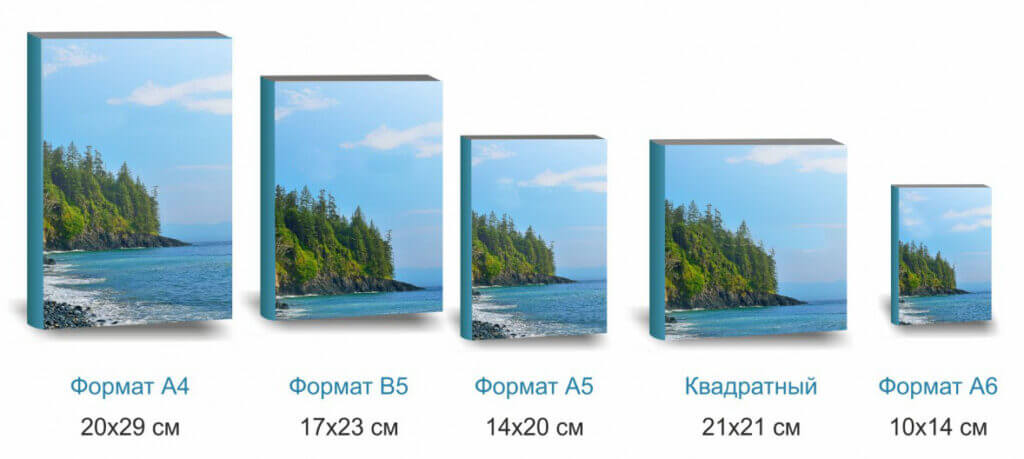
The most common and cost-effective format is A5 (half a standard sheet of paper). This is how most multi-page literature on the book market is published, and this format suits all types of books best. Other formats are more expensive.
The range of paper for an edition
When it comes to publishing a book, one of the important decisions is the choice of paper. It can make a big difference to the look and feel of a book, as well as to its durability and readability. Below is an overview of the different types of paper.
- Offset paper is commonly used for printing books. It is an economical option that gives high print quality and is ideal for books with a large number of pages.
- Glossy coated paper is used for high-quality editions such as magazines and picture books. It gives a smooth, reflective surface that makes images and graphics look brighter. It is more expensive than offset paper.
- Matt coated paper gives a smooth, non-reflective surface that is easy on the eyes, which makes it ideal for books with a lot of text.
- Newsprint is an inexpensive uncoated paper commonly used for newspapers and low-cost books. It is light and low-grade, so it is not ideal for high-quality printing, but it is an affordable option for printing books in large quantities.
- Recycled paper is made from post-consumer waste. It is an environmentally friendly option that is becoming more and more popular for books. It gives good print quality, although it may not be as durable as other types of paper.
- Specialty paper is designed for a specific application, for example for printing on one side only or for use with special inks. It is usually more expensive than other types of paper, but it can have unique properties that make it ideal for certain kinds of books.
So which paper is used for publishing books? The answer is that it depends on the type of book you are publishing, as well as on your budget and your printing goals. Whether you are publishing a coffee-table book, a picture book or a novel, it is worth considering the different types of paper and choosing the one that best suits your needs.
Printing methods at the Kavun printing house
The press room is equipped with professional machinery, which allows large runs to be printed quickly and to a high standard. Quality control is a very important stage of printing: using special printing marks and a microscope, our printers regularly check that the colours in your edition match the approved proof as closely as possible.
It is also very important to decide on the colour of the printing, black and white or full colour, because the cost of printing the book depends on it. We offer paper of different weights.
In most cases books are printed on these types of paper:
- offset;
- coated, matt and glossy;
- designer paper.
We use digital technology for small and medium runs, and the offset method for large quantities. All orders are completed in the shortest possible time, which the manager calculates when the order is placed.
With our help you can also print a book in a single copy, for example to make an original gift. It is especially pleasant to hold a book that is not only interesting but also well made.
Publishing books in small runs
Small-run book printing has become increasingly popular in recent years thanks to advances in printing technology and the rise of self-publishing. It allows authors and publishers to produce high-quality books in small quantities, which makes it ideal for:
- testing the market;
- reaching a niche audience;
- releasing a limited number of copies.
Below is an overview of the small-run book printing process:
- Before printing a book in a small run, the files have to be prepared for printing. This usually means converting your manuscript into a print-ready format such as PDF and sending it to the printing house. It is important that the files are of high quality and free of errors, as this ensures that your book is printed correctly and to your specifications.
- Printing a book in a small run is a straightforward process, and many printing houses specialise in it. The printing house uses digital printing technology to produce your book, and you can order even a single copy, which allows you to test the market or reach a specific audience.
- When printing books in small runs you can customise the book to your specific needs and preferences. This includes everything from the choice of paper to the type of binding and the size and format of the book. The options extend to the cover design, which can be personalised with unique images, text and graphics.
- Small-run book printing is cost-effective, because digital printing technology has made it possible to produce high-quality books in small quantities at an affordable price. This lets authors publish a book in a small run without breaking the bank.
- Printing books in small runs is also fast and efficient. We produce your book in a few days, and you receive the finished product within a week. This lets you bring your ideas and stories to life quickly and deliver them to your audience in good time.
Types of book binding
Our printing house prints books and offers a variety of bindings:
- perfect binding (adhesive, unsewn);
- sewn and glued binding;
- integral binding (stapling or a spiral).
When a hardcover book is made, the printed sheets are first folded into signatures on a special folding machine and are then sewn with thread on the appropriate equipment. The hard case is prepared separately, and there are many ways of making it. It can be paper laminated with glossy or matt film, leather or leatherette, of which there are many kinds. The case can be finished with foil stamping, embossing, selective UV varnish and so on.
A soft cover means a lower cost price and a lower production speed. It is made of coated paper with a weight of 170-300 g/m2, or of single-sided or double-sided coated board with a weight of 170-250 g/m2. A soft cover can additionally be laminated with glossy or matt film, finished with selective UV varnish, foil stamping and other techniques. It is joined to the block at the spine.
At the customer’s request we also make bookmarks.
Pre-press and post-press services
Before a print run of books goes to press, the client always looks through the final file and approves it if everything is in order.
Post-press work is also carried out in our own workshop so that orders are completed quickly. This saves a lot of time that would otherwise be spent transporting the printed sheets to an outside finishing shop.
How important is the design of a book
There is an old saying that people are judged by the clothes they wear. Three quarters of information is taken in visually, and a book, as an object, confirms this rule. This is above all a question of the cover and of the design of the edition in general. They are often the reason a book is bought or left on the shelf.
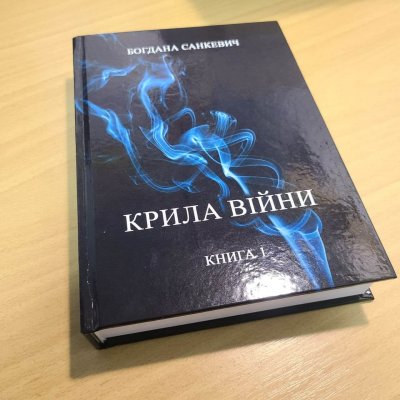
It is the title and the cover that sell, not the content of the book. Unless we are talking about an author who is a brand in their own right, the success of a book depends on the designer, which means on a precise brief and on control over the work. The cover is packaging, just as it is for any other product. It matters both for holding what is inside and for explaining what is inside, and also for promotion and advertising. In other words, the cover has to attract attention and encourage the reader to pick up the book and buy it.
When printing books to order we do not treat the cover design separately from the artistic design of the content. There has to be a coherent idea behind the construction of the book, and only then does it become clear what the artist has brought out onto the cover.
Calculating the cost of printing books
The cost of printing a book can vary greatly depending on a number of factors, including the size and format of the book, the number of pages, the type of paper and cover and the printing process itself. Below is an overview of how various factors affect the price:
- The number of pages in a book is one of the most significant factors in the cost of printing. The more pages the book has, the higher the printing price will be.
- The format and size of the book also affect the cost of printing. A large book usually costs more than a small one, and a book in a more complex format, such as a hardcover or an enlarged edition, will also cost more.
- The type of paper and cover you choose. Using higher-quality paper or a more complex cover design increases the cost of printing. Using plainer paper or a simple cover design helps to keep printing costs down.
- The printing technology. Offset printing is generally more expensive than digital printing, but it is a higher-quality process that is ideal for large runs. Digital printing is a more cost-effective option for small runs and is ideal for self-publishing authors and small publishing companies.
- The number of books ordered. The more books you order, the lower the price per copy, because the printing house can spread the production costs over more copies, which makes it more cost-effective for you.
So how much does it cost to print a book at a printing house? The answer is that the cost can vary greatly, and it is important to take the various factors into account when estimating it.
Working with the customer’s materials
Our printing house is located in the city of Dnipro. Working remotely allows us to cooperate with clients from different cities and countries: you can order book printing online on the site and send us your materials, and our specialists will check that the files have been prepared for printing correctly.
We also calculate the cost. To work out the price of printing a book we need to know:
- the print run;
- the format (in mm);
- the weight and grade of paper for the inner block and for the cover;
- the printing colours of the cover and of the inner block;
- whether there are illustrations in the inner block and how many colours they use;
- the type of cover;
- the method of binding the inner block;
- the finishing of the cover;
- the assignment of ISBN, UDC and BBK numbers;
- the types of work needed to prepare the electronic version of the book.
Our printing house offers the best prices for book publishing. The finished print run is sent by any transport company, and collection in person and courier delivery within Dnipro are also available.
What's included in the service
Provision of ISBN numbers
Computer typesetting
Editing
Design
Layout
Printing of a proof copy
Output of photoforms
Collating
Binding of the blocks
Finishing
Gluing of the printed cover
Lamination
Foil stamping
Trimming and packing of the finished product
Workflow
Planning
Before starting to publish a multi-page edition it is important to plan the project carefully. This includes deciding on the size, the format and the paper for your book, as well as the number of copies required. You may also want a custom cover design, which our specialists can create.
Preparation of the files
Next the files have to be prepared for printing. This usually means converting your manuscript into a print-ready format, most often a PDF file. It is important that the files are of high quality and free of errors, as this ensures that the book is printed correctly and to your specifications.
Printing
Printing a book at a printing house is a straightforward process. We use state-of-the-art printing equipment and technology to produce your book to order. As a rule this includes proof copies, which you review and approve before the actual print run begins.
Binding
The printed book is bound according to your requirements. It can be a hard or a soft cover, stapling, or a plastic or metal spiral. The printing house carries out the binding process and makes sure that your book is of high quality and ready for distribution.
Delivery
Finally the edition is packed and sent to your address. We offer delivery services and can send your books directly to your customers, which is a convenient and cost-effective solution if you sell your book online.
Ready to get started?
Submit your request - a manager will contact you within the day with a detailed quote.