
Proofreading and editing books
A book with spelling mistakes and wrongly placed punctuation marks spoils the impression the edition makes. Qualified literary editors with extensive experience will proofread a text of any genre, form, complexity and subject matter before printing.
- Experienced literary editors and proofreaders
- Any genre and any subject matter
- Proofreading in 2 stages
- Paper and electronic editions
A book with spelling mistakes and wrongly placed punctuation marks spoils the impression, especially when it is a finished product that has already reached the reader. If you are on our site, it means you need your text proofread – and it has to be done before the book is printed. We have qualified literary editors with extensive experience in the literary processing of texts of any genre, form, complexity and subject matter.
The difference between proofreading and editing
Proofreading and editing are two important stages of text processing that are often confused with each other. Both aim to improve the quality of the text, but they differ in their objectives and their methods.
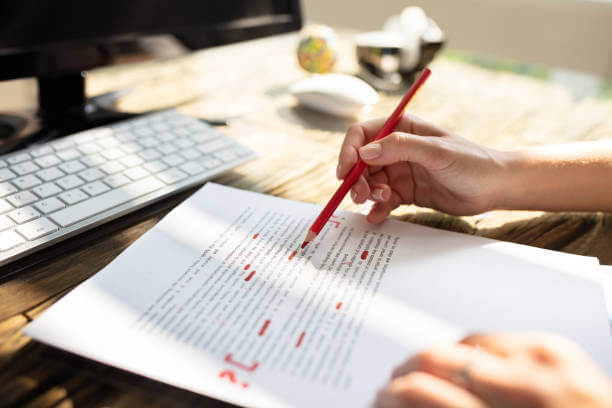
Proofreading is the process of checking a text for technical errors, such as:
- spelling errors (words spelled incorrectly);
- punctuation errors (incorrect use of punctuation marks);
- text errors (typos, omissions or extra characters);
- tautology (repetition of the same words);
- incorrect formatting of the text (for example double spaces or wrong indents).
The proofreader’s job is to check the text carefully for such errors and correct them so that the text is technically as correct as possible. Proofreading is usually carried out after the main work on the text is finished and before printing or publication.
Editing, unlike proofreading, is a deeper process of working with the text. It includes:
- grammatical analysis of the text (correct agreement of the parts of speech, use of cases, tenses and so on);
- syntactic analysis (sentence construction and the logical structure of the text);
- stylistic processing (improving the style, avoiding language cliches, matching the style to the genre);
- lexical analysis (the choice of words, checking their accuracy and their relevance to the context);
- logical analysis (the sequence and the logical coherence of the ideas);
- fact checking (the reliability and accuracy of the facts and data given).
The editor not only corrects errors but also helps the author improve the text on every level, making it clearer, more logical, more consistent stylistically and more interesting for the target audience. The editor may also suggest changes in the structure of the text – adding or removing certain parts in order to improve its content and its presentation.
The main differences are:
- The goal. Proofreading is aimed at eliminating technical errors, while editing covers work on the content, the style and the logic of the text.
- The depth of processing. Proofreading focuses on correcting surface errors, while editing analyses the text deeply, including both its content and its form.
- The stage of the work. Proofreading is usually done after the editing has been completed and before publication, while editing is carried out at the early stages of work on the text, when it can still change significantly.
What the proofreading service includes
Do you think you can do this yourself? Only an experienced proofreader will be able to find all or most of the errors according to all the rules of grammar and punctuation. Someone who has composed and written the book personally has a blurred view of it and will not notice the mistakes or typos. Proofreading is an important prepress step for any multi-page literature – books, magazines, monographs, dissertations, theses, diploma and term papers and so on.
Our specialists proofread the files sent by the client in two stages.
A proofreader is a person who reviews and corrects written material before it is published. Proofreaders make sure that written materials such as books, magazines, newspapers, websites and advertisements are free of errors, typographical mistakes, grammatical errors and inconsistencies. The aim is for the final product to be polished and free of errors.
What errors can a proofreader find in a text?
A proofreader is a specialist who makes a text perfect. Their task is not only to correct obvious mistakes but to improve the text as a whole. It is thanks to the proofreader that a text becomes readable, correct and accurate, which matters for books and for any other printed material alike. Below are the main types of errors a proofreader finds when working with a text.
Spelling mistakes
Spelling mistakes are words that are spelled incorrectly. They can be errors in the letters of a word, in the spaces or in extra characters. Such mistakes affect the perception of the text considerably and can even change its meaning, so the proofreader checks every word carefully.
Punctuation errors
Punctuation plays an important role in the correct understanding of a text. A comma in the wrong place or a missing mark can change the meaning of a sentence completely. The proofreader corrects all punctuation errors so that the author’s ideas are structured correctly.
Grammatical errors
Grammatical errors include the incorrect agreement of parts of speech – in number, gender, case and so on. They arise from the wrong use of endings or word forms. Such errors have a negative effect on the perception of the text, so the proofreader pays particular attention to grammatical correctness.
Syntactic errors
Syntactic errors arise from the incorrect construction of a sentence or the wrong word order. They can make a sentence hard to understand or even distort its meaning. The proofreader helps to make the text more logical and clear.
Semantic errors
Semantic errors concern the meaning of words and phrases that do not fit the context. Using the wrong word can change the meaning of the text considerably or make it unclear. The proofreader pays attention to such nuances so that the meaning is conveyed exactly.
Stylistic errors
Stylistic errors arise from the use of inappropriate stylistic devices or language cliches. Using unnecessary words – for example “more preferred” instead of “better” – is a typical example of a stylistic error. The proofreader works to make the text match the style and the genre in which it is written, so that it reads naturally and expressively.
Tautology
Tautology is the repetition of the same or similar words in a text. The proofreader finds and corrects such places in order to remove unnecessary repetition and make the text clearer.
Lexical errors
Lexical errors arise from the wrong choice of a word or from confusing words that sound alike. The words “production” and “output”, for example, are often mixed up although they mean different things. The proofreader helps to avoid such mistakes by choosing the right word for the context.
Logical errors
Logical errors occur when parts of a text contradict each other or do not fit together logically. A statement such as “I was at home yesterday, but I was not there” is an example of a logical error. The proofreader checks the text for such contradictions and helps to make it coherent and consistent.
Factual errors
Factual errors are incorrect data or statements that are not true. “Kyiv is the capital of Poland” is an obvious factual error. A proofreader working with academic or historical texts in particular has to check the facts to make sure they are correct.
The work of a proofreader is extremely important for any text. Correcting spelling, grammar, punctuation and other types of errors helps to create a high-quality, clear and professional text. After a thorough check the text becomes correct, logical and aesthetically pleasing, which increases its value and its effectiveness for the reader.
By using the services of a professional proofreader you can be sure that your text will be flawless in every respect. This is an important step on the way to creating high-quality printed material.
Why do mistakes appear in manuscripts?
- the author does not know the spelling rules well enough;
- third-party materials that already contain errors are used;
- a poor translation from another language;
- inattention, which above all leads to typos;
- tiredness or feeling unwell;
- writing the work to a very short deadline.
All of these problems can be solved – but only if proofreading is ordered.
What we can proofread
- books (fiction, technical books, textbooks);
- diploma works;
- term papers;
- technical documentation for equipment;
- company websites;
- articles;
- business correspondence.
Wherever there is text, it has to be literate.
Calculating the price of the proofreading service
We strongly recommend not saving money at such an important stage, because mistakes are a heavy blow to the author’s image. Grammatical mistakes in the text of a thesis or a dissertation will lead to problems at the defence, and in advertising material or in the text on your site they equally spoil the image of the company that placed the advertisement.
The format of your work does not matter. We proofread texts not only for paper books but also for electronic ones, as well as for business documents and websites. The factors that influence the price of the service are:
- the volume of the work and its subject matter;
- the deadline for completing the order;
- the presence of tables, footnotes and diagrams;
- the complexity and the specific character of the text;
- the average density of errors in the text;
- the unification of terms and names.
These are only the main points. Our managers can assess the complexity of the work and calculate the price only after they have seen your materials.
Do you want your material to be worthy of its author, to look solid and to arouse not only interest but also respect? Then the proofreading of the book should be done by professionals.
What's included in the service
Correction of grammatical, morphological and word-formation errors
Checking the syntax, the spelling and the punctuation
Formatting the text according to the unified requirements for the edition
Correction of errors after the layout
Clearing the text of surzhyk and of inappropriate dialect
Ready to get started?
Submit your request - a manager will contact you within the day with a detailed quote.