
Publication formats
Formats of book and magazine publications according to GOST - page sizes and orientation, sheet shares, type area and the recommended margins, plus the main types of book binding and their advantages.
- Page formats of book and magazine publications according to GOST 5773-90
- Sheet shares and the standard 60×90/16 notation explained
- Type area and recommended margins, including the minimum margins of standard 29.124-94
- Main types of binding: hardcover, paperback, case and coil binding
Book printing has come a long way since the days of Johannes Gutenberg and the invention of the printing press in the 15th century. Today printing production is a highly automated process that makes it possible to produce a large number of books in a relatively short time.
Thanks to modern technology, book printing has become a much faster and more efficient process.
Tables of printing page formats and their margins according to GOST. For offset printing (the size of the spine margin is given for a 7BTs hard cover)
Many factors have to be taken into account when choosing the page format of a printed document. First of all you need to decide what the document is for: will it be read from cover to cover, or will it be used for reference? Once you know how the document will be used, you can choose a suitable page size.
The most common page size for ordinary reading is 22×28 cm. It is convenient to use and fits easily into a standard paper box. For documents that will be used for reference the page size can be larger; 28×43 cm is a common size for reference documents, because it holds more information on each page and makes it easier to find a particular item.
After the page size you need to decide on the orientation. The two most common orientations are portrait and landscape. Portrait is taller than it is wide, landscape is wider than it is tall. The choice depends on the content of the document: if it consists mostly of text, portrait orientation is usually the better choice, and if it consists mainly of graphics or images, landscape is better.
Tables according to GOST 5773-90. Formats of book publications
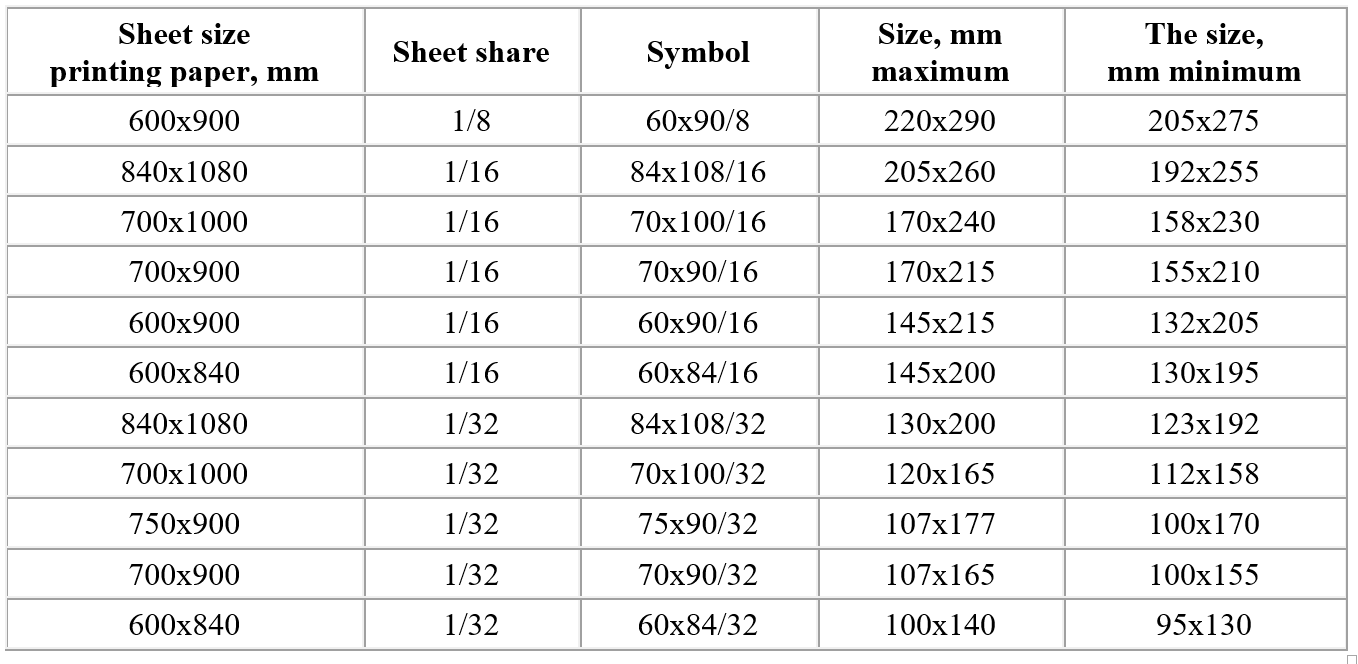
When it comes to books, size really does matter. But how is the size of a book determined? Here are the points to keep in mind:
- The size of a book is usually determined by the dimensions of its cover.
- The size is also affected by the type of binding. A book in a perfect binding, where the pages are glued directly to the spine, is usually a little smaller than a book in a case binding, where the pages are sewn together and then joined to the spine.
- The type of paper matters too. A book printed on plain paper is usually slightly smaller than the same book printed on heavy glossy paper.
- Finally, the size depends on the way the book is trimmed, that is on the process of cutting the pages to their final size. Trimming on four sides gives a smaller book than trimming on three sides.
Keep all of these factors in mind when you are trying to determine the size of a book. And if you are still not sure, ask a librarian or a bookseller for help.
Tables according to GOST 5773-90. Formats of magazine publications
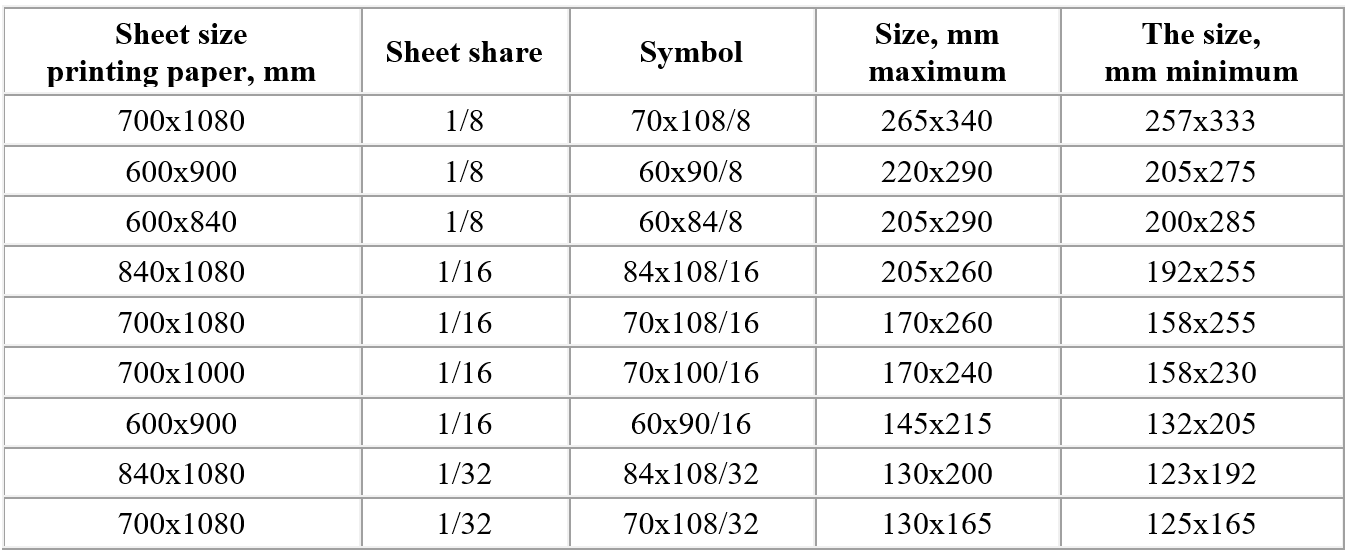
Glossy magazines come in many different sizes, from large and bulky to small and thin. The size is often determined by the amount of content the magazine has to hold: a large glossy magazine may be needed for a large amount of text, while a smaller one may carry only a few images. The size can also be affected by the type of binding, because certain bindings make a magazine look larger or smaller than it really is.
Because glossy magazines are made in such a variety of sizes, there is sure to be one that fits your needs – a large magazine for a lot of text or a small one for a few images.
A sheet share is the part of a sheet of printing paper on which one page of a book is printed. Different numbers of pages can be placed on one side of a sheet. For example, 60×90/16 means a sheet of printing paper 60×90 cm in size carrying 16 pages, that is 16 shares. If the sheet is printed on both sides, the shares are still counted on one side only: in the example above, one side of a 60×90 cm sheet holds 16 shares (pages). The share is written as 1/16, and the standard notation is 60×90/16. For books and magazines the page sizes, the printing sheets and the shares can be determined from the GOST tables.
Sheet shares for non-standard page sizes of books and magazines are calculated by a printing technologist. Non-standard editions include large formats, souvenir editions and miniature books. If you want to know the sheet share for a book with a non-standard page size, ask the printing house for a calculation.
Type area formats and recommended margins for book pages
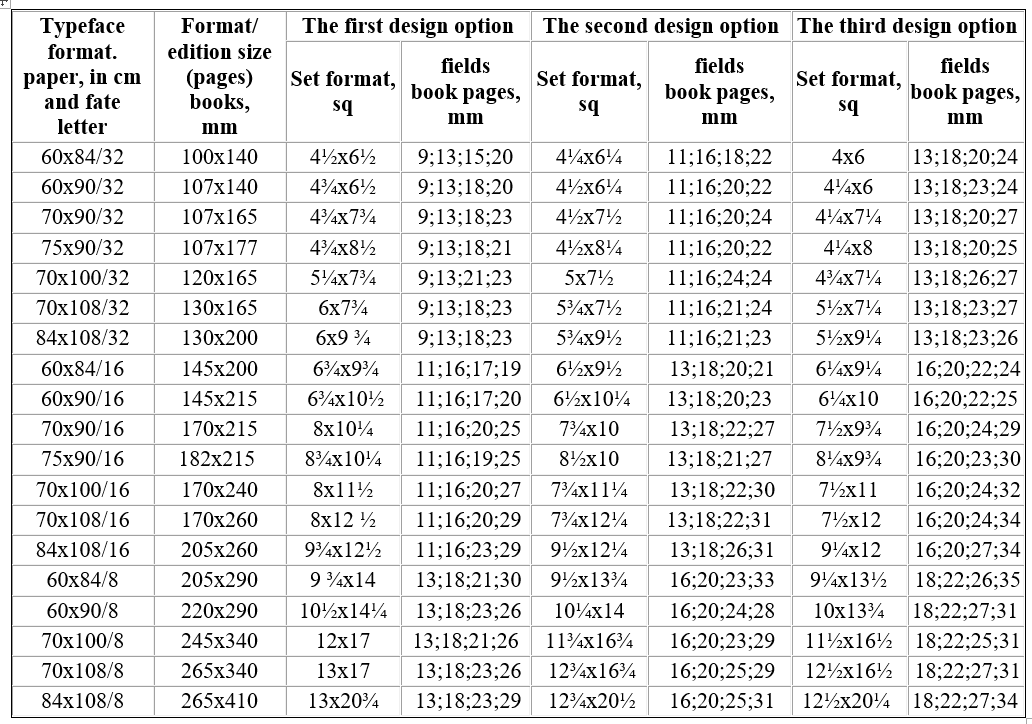
The margins of a book are the white space that surrounds the text on a page. They are an important part of the design and they affect how the text reads. The size of the margins depends on the size of the book and on the type of paper used.
The standard margins for a paperback book are 1 inch (2.54 cm) on all sides. For a hardcover book the margins are usually 1.25 inches (3.175 cm) on the outer edges and 1 inch (2.54 cm) on the inner edges.
The margins can be adjusted to make the text look larger or smaller: with wider margins the text looks smaller, with narrower ones it looks larger. Margins also affect the spacing of the text on the page. If they are too small the text looks cramped and is hard to read; if they are too large the text looks scattered and is hard to follow.
The best way to find the right margins for a book is to try different sizes and ask the opinion of the people who are going to read it.
The four margins of a page are the spine margin, the head margin, the outer margin and the foot margin.
The square is a typographic unit of measurement: 1 square = 48 pt = 18.0412 mm, rounded to 18 mm in Ukraine, and 16.944 mm, rounded to 17 mm, in the English-American system.
Minimum margin sizes for publications according to state standard 29.124-94

The minimum margin is the narrowest distance between the text and the edge of the paper that printing equipment can safely reproduce.
Please note that these standards were required and up to date for offset printing on large sheets of A1 format and for large print runs of 10,000 copies and more. Today this information is not especially relevant, because modern books are printed on offset machines up to A2 format with print runs from 1,000 copies, and on laser printers and risographs up to A3 format.
What's included in the service
Hardcover
Hardcover books are made with stiffer and more durable board covers than paperbacks. The pages are glued into the spine, which holds them more securely than in paperbacks. Hardcover books often have a dust jacket that protects the cover and can also carry information about the book - the title, the author and the publisher. They cost more to produce but last longer, so they are chosen for libraries and other institutional collections and for special editions meant to be kept and read over many years.
Paperback
A paperback is a book with a paper or cloth cover held together with staples, thread or glue; the term also covers books with a flexible plastic or leather cover. Paperbacks are usually cheaper and lighter than hardcover books, which is a real advantage if you travel or want to carry several books at once.
Case binding
In a case binding the pages and the cover are sewn together with thread and the spine is then glued to the rest of the book. The result is a stronger book that withstands more wear, which is why case binding is often used for hardcover editions - it also gives them a more finished look.
Coil binding
In a coil binding the pages are held by a metal or plastic spiral. The book opens out flat, which is ideal for editions that are used often, such as textbooks. Coil binding is also very durable, so it is a good choice for books in daily use.
Less common bindings
There are also less common options such as saddle stitching and spring binding, but the most popular choices remain perfect binding, case binding and coil binding. When choosing a binding, weigh up your budget, the intended use of the book and the overall look you want.
Workflow
Creating the layout
The first step in modern book publishing is the layout of the book, which is normally made in specialised computer software.
Sending the file to the printing house
When the layout is finished it is sent to the printing shop, where a trial copy can be produced for approval.
Printing
After the proof has been approved the printing house starts printing. A digital printing machine is used for this, which prints a large number of books quickly and accurately.
Binding and trimming
Once the books are printed they are bound and trimmed to their finished size.
Ready to get started?
Submit your request - a manager will contact you within the day with a detailed quote.